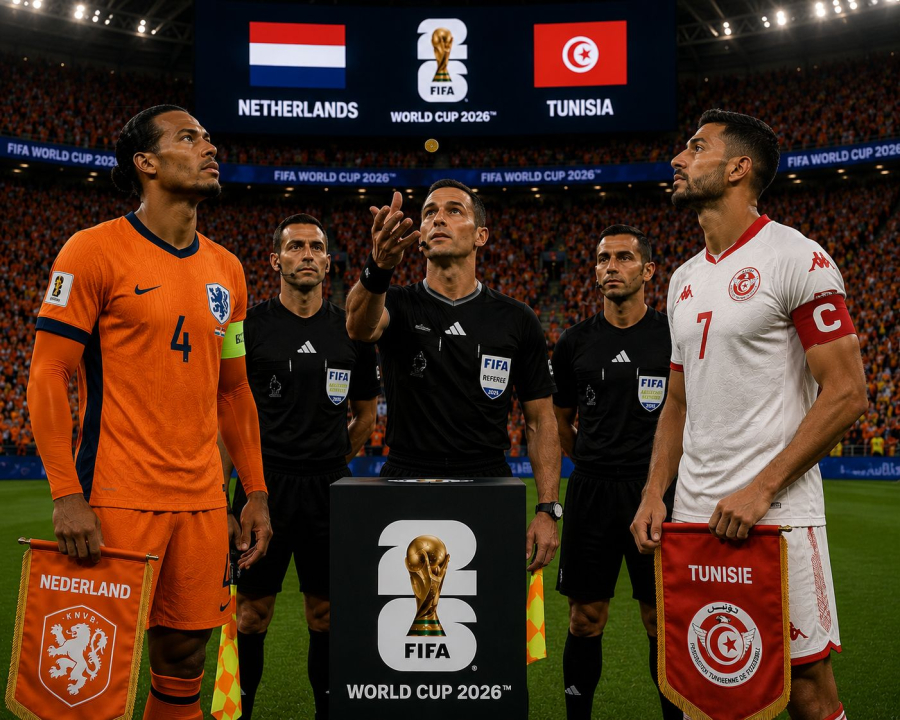
In a World Cup group-stage setting, every match is a mini-final. If the Netherlands are drawn into a group that includes Tunisia, the Dutch taking three points from that head-to-head can be more than just “a win.” It can become the result that shapes the entire group table—through points, tie-breakers, confidence, and even the quality of the knockout-path they earn.
This article breaks down the biggest reasons a Netherlands victory over Tunisia could be a decisive step toward finishing top of the group—and why that first-place target is usually worth chasing.
First place in the group is a real competitive advantage
Before getting into the match-up itself, it helps to clarify why group leadership matters. In most World Cup formats, group stage performance determines who advances and where they land in the knockout bracket.
- Winning the group typically delivers a more favorable Round of 16 pairing (on paper) than finishing second.
- It can reduce risk of meeting another tournament favorite too early.
- It helps manage squad workload if qualification is secured earlier, allowing smarter rotation in the final group match.
None of this guarantees an easier tournament—World Cups are unpredictable—but topping the group generally improves the odds of staying in the competition longer.
Three points are the foundation: the simplest route to first place
At the most basic level, a Netherlands win against Tunisia adds three points to the standings. That sounds obvious, but it is exactly why group matches against well-organized opponents matter so much: points are scarce, and a single slip can turn a “comfortable” group into a tense final day.
To keep things clear, here is the standard points structure used in major international tournaments, including the World Cup.
| Result | Points Earned |
|---|---|
| Win | 3 |
| Draw | 1 |
| Loss | 0 |
Because each team plays only three group games, every point is amplified. A win over Tunisia can be the difference between controlling your own destiny and needing help from other results.
Goal difference: why “how you win” can matter almost as much as winning
Group standings aren’t determined by points alone. When teams finish level on points, tournaments use tie-breakers—most commonly goal difference and goals scored, followed by additional criteria.
That is why a Netherlands win against Tunisia can be doubly valuable if it comes with a clean sheet or a multi-goal margin.
What goal difference can do for the Netherlands
- Creates separation from a rival that might also collect points elsewhere in the group.
- Reduces pressure in later games, where a draw might become enough to hold first place.
- Rewards consistency by turning solid performances into a concrete table advantage.
In short, three points get you moving. A strong goal difference can keep you ahead when the group gets tight.
Head-to-head implications: beating Tunisia directly can win mini-battles inside the group
Depending on the tournament’s tie-break regulations, results between teams tied on points may be used as part of the ranking criteria. Even when head-to-head is not the primary factor, the psychological and strategic effect of beating a direct competitor is significant.
If Tunisia are competing for the same qualification spots or taking points off other teams, beating them can create a valuable “buffer” the Netherlands can carry into the final matchday.
Why that buffer is so valuable
- It limits Tunisia’s maximum points total, lowering the threshold the Netherlands need to hit.
- It prevents momentum swings that can happen when an underdog gets a result and grows in belief.
- It can force Tunisia to chase results in later matches, which often creates more space for their opponents.
Momentum and belief: group winners often look like group winners early
World Cups are short, intense tournaments. A single win can change a team’s body language, clarity, and conviction. For a powerhouse like the Netherlands, beating Tunisia can do more than add points: it can reinforce the identity the Dutch want to carry into the knockouts.
Positive momentum shows up in practical ways
- Sharper decision-making in final-third moments because confidence is higher.
- More disciplined defending because the team trusts the plan and stays compact.
- Better game management when leading, including calmer possession and fewer unnecessary risks.
That type of momentum is especially useful in a group, where teams need to shift gears quickly from one opponent to the next.
Why this specific type of opponent can be a key test
Tunisia have historically been known as an organized, competitive international side capable of making matches uncomfortable. In a World Cup group, those traits matter because they can reduce the margin for error—particularly for teams that prefer to control games through possession and structure.
If the Netherlands earn a win against a disciplined opponent, it can signal that they are prepared for:
- Low-block defending that demands patience and high-quality chance creation.
- Transitional moments where one turnover can lead to a dangerous counter.
- Set-piece battles that often decide tight group games.
From an “aim to win the group” perspective, passing tests like these is part of building a reliable tournament profile—one that produces results even when performances are not perfect.
Squad management benefits: a win can unlock smarter rotation
Winning early or beating the right opponent can have a direct impact on how a coach manages minutes. If the Netherlands beat Tunisia and take control of the group table, they may be able to approach later fixtures with more flexibility.
Key benefits of that flexibility
- Protect key players from fatigue by reducing their minutes when safe to do so.
- Lower injury risk by avoiding unnecessary overload in a compressed schedule.
- Increase bench readiness by giving meaningful minutes to squad players before the knockouts.
This matters because knockout football often turns on small details: freshness, sharpness, and availability.
Knockout-path positioning: topping the group can shape the next two games
World Cup brackets are designed so that group winners and runners-up enter different slots in the Round of 16. While there is no such thing as a guaranteed “easy” opponent, the statistical reality is that group winners often avoid facing another group winner immediately.
If a Netherlands win against Tunisia contributes to finishing first, it can produce two major downstream benefits:
- Potentially a more favorable Round of 16 match-up, which increases the odds of reaching the quarterfinals.
- A clearer preparation plan because the likely opponent pool becomes more predictable.
At tournament level, that kind of edge is meaningful. The goal is not just to qualify—it is to qualify in a way that sets up a deep run.
What a “top-of-the-group” performance could look like in practice
If the Netherlands want to turn a win over Tunisia into a realistic push for first place, it often comes down to combining three ingredients across all group matches.
- Efficiency: taking chances in tight windows and avoiding wasteful spells.
- Control: limiting opponents’ high-quality opportunities and managing transitions.
- Professionalism: staying focused on points and tie-breakers, not just performance style.
Beating Tunisia fits naturally into this blueprint: it is the kind of match where discipline and clarity can deliver both points and tie-breaker advantages.
Bottom line: a Netherlands win over Tunisia can be a first-place accelerator
In a World Cup group, a single result can ripple through the entire standings. A Netherlands win against Tunisia can be important for finishing top because it delivers three points, strengthens goal difference potential, boosts momentum, and can improve the Netherlands’ ability to manage the squad and the bracket.
When the objective is to go deep in the tournament, these are not minor details—they are the building blocks of a group-winning campaign.
